Table of Contents
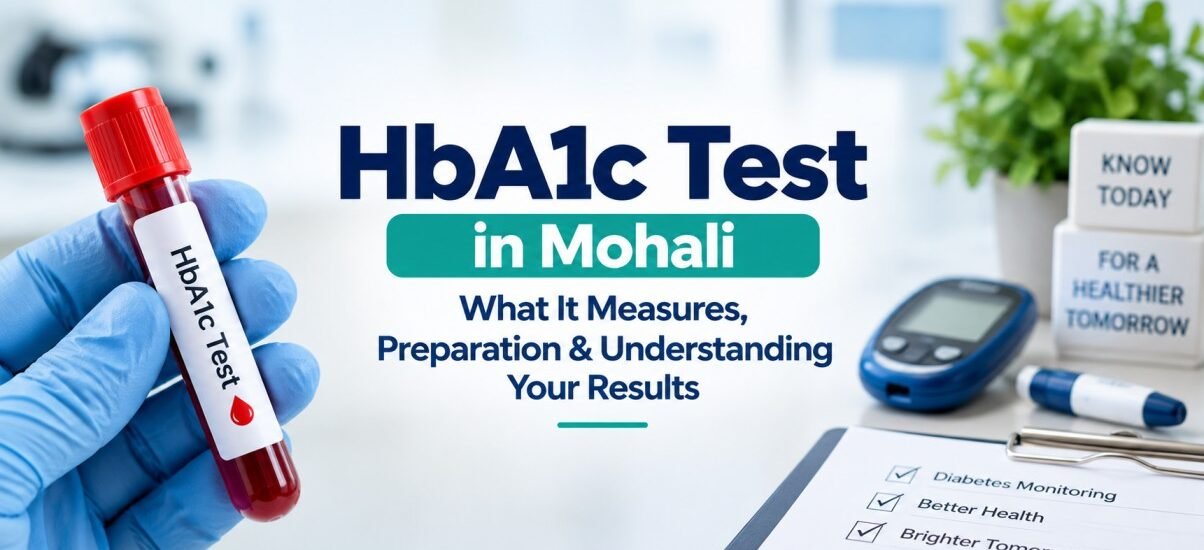
Blood sugar can change throughout the day depending on meals, activity, stress, medicines, and other factors. A single blood glucose reading therefore gives only a snapshot of what is happening at that particular moment. The HbA1c test in Mohali is different because it provides an estimate of your average blood glucose levels over roughly the previous three months.
The test is commonly used when healthcare professionals need to assess prediabetes or type 2 diabetes, and it is also an important part of ongoing diabetes monitoring. Unlike a fasting blood glucose test, an A1C test generally does not require fasting.
If your doctor has recommended an HbA1c test in Mohali, understanding what the test measures, how to prepare, what the results mean, and why the test may be repeated can make the process much easier.
What Is an HbA1c Test?
HbA1c stands for glycated hemoglobin. It is also commonly called A1C, hemoglobin A1C, or glycosylated hemoglobin.
When glucose circulates in the bloodstream, some of it attaches to hemoglobin, a protein found inside red blood cells. Since red blood cells generally remain in circulation for around three months, the amount of glucose attached to hemoglobin provides information about average blood glucose levels over that period.
The result is reported as a percentage. In general, a higher A1C percentage means that average blood glucose has been higher over the preceding months.
This makes HbA1c different from checking blood sugar at home, where each reading represents the glucose level at one particular point in time.
Why Is an HbA1c Test Done?
An HbA1c test in Mohali may be recommended for several reasons.
To Check for Prediabetes
Prediabetes means blood glucose levels are higher than the normal range but do not meet the diagnostic threshold for diabetes.
An A1C test can help identify people who may have an increased risk of developing type 2 diabetes. According to NIDDK, an A1C result from 5.7% to 6.4% falls within the prediabetes range for non-pregnant adults.
Identifying this stage can provide an opportunity to discuss lifestyle changes and appropriate follow-up with a healthcare professional.
To Help Diagnose Type 2 Diabetes
A1C is one of the tests used to diagnose type 2 diabetes.
An A1C level of 6.5% or above is in the diabetes range. However, when a person does not have clear symptoms, an abnormal diagnostic result generally needs confirmation with repeat testing or another accepted diabetes test.
A test result should therefore not be interpreted on its own without considering the person’s overall health and medical history.
To Monitor Existing Diabetes
People who already have diabetes may have A1C testing as part of regular medical follow-up.
The test can help a healthcare professional understand how blood glucose has been managed over time and whether the current treatment and lifestyle plan may need review. The appropriate testing frequency varies from person to person.
HbA1c Test in Mohali: What Does It Measure?
The main purpose of an HbA1c test is to estimate average blood glucose over approximately the previous three months.
It is important to understand that this does not mean the test gives an exact record of every blood sugar level during those three months.
For example, two people could have a similar A1C result while experiencing different patterns of high and low glucose during the day. A1C is a longer-term average and does not replace other monitoring methods when those are recommended by a healthcare professional.
This is why your doctor may consider A1C together with symptoms, home glucose readings, fasting glucose, medicines, medical history, and other test results.
HbA1c Normal Range: What Do the Numbers Mean?
For non-pregnant adults, commonly used A1C categories are:
| HbA1c Result | General Interpretation |
|---|---|
| Below 5.7% | Normal range |
| 5.7%–6.4% | Prediabetes range |
| 6.5% or above | Diabetes range |
These ranges are used for diagnosis, but an individual result should always be interpreted in context.
A diagnosis should not be made simply by looking at an online chart. If your result is unexpectedly high or falls near a diagnostic threshold, your doctor may recommend another test or repeat testing.
Pregnancy is another important situation because different tests and diagnostic approaches may be used for gestational diabetes. A1C is not the standard test for diagnosing gestational diabetes later in pregnancy.
Does HbA1c Require Fasting?
One of the common questions about an HbA1c test in Mohali is whether fasting is necessary.
Generally, no.
You can normally eat and drink before an A1C blood test because the food you have recently eaten does not directly change the A1C measurement in the same way it can affect a fasting glucose reading.
This is one reason the test is convenient for many patients.
However, if your doctor has ordered an A1C along with other tests, such as a fasting glucose or lipid profile, you may still be asked to fast because of those other tests.
So, always follow the preparation instructions provided by your healthcare professional or diagnostic laboratory.
How to Prepare for an HbA1c Test
In most cases, special preparation is not required for an A1C test.
Before visiting the laboratory:
- You generally do not need to fast specifically for A1C.
- Drink water normally unless your healthcare provider has given different instructions.
- Take your regular medicines as instructed unless your doctor tells you otherwise.
- Inform your doctor about existing medical conditions and medicines.
- If other blood tests have been ordered at the same time, check whether fasting is required.
- Carry previous reports if the test is being done as part of ongoing diabetes monitoring.
The actual blood sample can be collected from a vein, and some settings may use a finger-stick method for monitoring.
What Happens During an HbA1c Test?
The process is generally straightforward.
A healthcare professional or laboratory technician collects a small blood sample. The sample is then analyzed to determine the percentage of glycated hemoglobin.
For a routine laboratory test, you may only experience a brief pinch when the needle is inserted.
There is usually no complicated preparation or procedure involved.
If you are having multiple blood tests on the same visit, the laboratory may collect the samples together.
How Is HbA1c Different From a Blood Sugar Test?
A regular blood glucose test and an A1C test provide different types of information.
Blood Glucose Test
A blood glucose test measures your blood sugar at a particular moment.
For example, a fasting glucose test measures blood glucose after a period without food. A random glucose test can be performed at another time, depending on the clinical situation.
HbA1c Test
A1C provides an estimate of average blood glucose over the previous two to three months.
This means one test looks at a current snapshot, while the other provides a longer-term picture.
Healthcare professionals may use both types of tests depending on the reason for testing.
HbA1c and Estimated Average Glucose
Some laboratory reports may include estimated average glucose (eAG) along with the A1C result.
The eAG converts the A1C percentage into a glucose measurement that is easier to compare with the units used by many home glucose meters.
For example, the CDC provides approximate relationships between A1C and estimated average glucose, such as an A1C of 6% corresponding to an eAG of about 126 mg/dL and 7% corresponding to about 154 mg/dL.
However, eAG should not be expected to match every individual glucose reading. Your daily glucose measurements can move up and down while the A1C represents a longer-term average.
Why Can HbA1c Results Sometimes Be Different From Blood Sugar Readings?
It is possible for your A1C result and individual glucose readings to appear different.
For example, someone may have relatively normal fasting readings but experience higher glucose after meals. Conversely, another person may have different glucose patterns that produce a similar overall A1C.
Certain medical conditions can also affect A1C accuracy.
These may include:
- Some types of anemia
- Certain blood disorders
- Kidney failure
- Liver disease
- Blood loss or transfusion
- Pregnancy
- Certain hemoglobin variants
- Some medicines
The CDC and NIDDK note that these factors can affect how accurately A1C reflects average glucose.
If your A1C result does not appear to match your home glucose readings, discuss the difference with your doctor rather than assuming one result is automatically incorrect.
Who May Need an HbA1c Test?
An A1C test may be considered for people who have risk factors for prediabetes or type 2 diabetes, or for those who have already been diagnosed with diabetes.
Your doctor may consider factors such as:
- Family history of diabetes
- Overweight or obesity
- Previous high blood sugar results
- High blood pressure
- Abnormal cholesterol levels
- Physical inactivity
- Previous prediabetes
- Symptoms that may suggest high blood glucose
- Existing type 2 diabetes
Not everyone needs testing at the same frequency. Your healthcare professional can recommend an appropriate schedule based on your age, risk factors, medical history and previous results.
When Should You Discuss Your HbA1c Result With a Doctor?
If you receive your report and the result is outside the normal range, it is important to understand what it means before making changes to your diet or medicines.
You should discuss your result with a doctor if:
- Your A1C is in the prediabetes range.
- Your A1C is in the diabetes range.
- Your result has increased compared with an earlier report.
- Your A1C does not match your home glucose readings.
- You already have diabetes and your levels are changing.
- You have symptoms such as excessive thirst or frequent urination.
- You have another medical condition that may affect A1C accuracy.
A high result does not automatically tell the complete story. Your doctor may recommend repeat testing or another glucose test depending on your situation.
Can HbA1c Be Used to Track Diabetes Control?
Yes. A1C is widely used as part of diabetes management because it provides information about longer-term glucose levels.
Instead of looking at one day’s reading, your healthcare professional can compare A1C results over time to understand the general direction of your glucose control.
However, there is no single A1C target that is appropriate for every person with diabetes. Individual goals may depend on age, duration of diabetes, other health conditions, risk of low blood sugar and other factors. NIDDK notes that treatment goals should be discussed with a healthcare professional rather than applied as a universal number.
How Lifestyle Changes Can Affect HbA1c
For people with prediabetes or diabetes, healthy lifestyle habits can be an important part of managing blood glucose.
Depending on your individual condition, your healthcare professional may recommend:
A Balanced Eating Pattern
Choosing nutritious foods and paying attention to portions and carbohydrate intake can help support blood glucose management.
Regular Physical Activity
Physical activity can improve overall metabolic health and may help with blood glucose management.
Maintaining a Healthy Weight
For people who are overweight and have prediabetes, even moderate weight loss can support efforts to reduce the risk of progressing to type 2 diabetes.
Taking Prescribed Medicines Correctly
If diabetes medication has been prescribed, it should be taken according to your healthcare professional’s instructions.
Do not stop, increase or reduce medication based only on an A1C report without discussing it with your doctor.
HbA1c Test in Mohali for Regular Diabetes Monitoring
For people who need ongoing diabetes monitoring, an HbA1c test in Mohali can provide useful information about longer-term blood glucose levels.
It can be especially helpful when compared with previous A1C results, other glucose measurements and the patient’s overall health history. Looking at the trend over time can provide more useful information than focusing on one isolated number.
The frequency of testing depends on individual circumstances and the treatment plan. People whose diabetes is stable may have a different testing schedule from those whose treatment has recently changed or whose glucose levels are not within their target range.
HbA1c Testing at Pulse Clinics & Diagnostics
At Pulse Clinics & Diagnostics, patients can discuss their blood sugar concerns and diagnostic requirements with the healthcare team. If an A1C test is recommended, the result can be considered alongside symptoms, previous reports, blood glucose readings and other relevant health information.
For someone who is concerned about diabetes, prediabetes or changing blood sugar levels, getting the appropriate test is only one part of the process. Understanding the result and knowing whether further evaluation or regular monitoring is needed are equally important.
Patients visiting for testing can also keep previous reports and medication details available so that their healthcare professional has a clearer picture of their medical history.
What to Remember Before Getting an HbA1c Test
If you have been advised to get an A1C test, remember these simple points:
- A1C reflects average blood glucose over approximately three months.
- You generally do not need to fast specifically for the test.
- Below 5.7% is generally considered the normal range.
- 5.7%–6.4% falls in the prediabetes range.
- 6.5% or above is in the diabetes range for diagnosis.
- An abnormal diagnostic result may need confirmation.
- Certain medical conditions can affect the accuracy of A1C.
- Your personal diabetes target may be different from someone else’s.
- Do not change prescribed medication based only on an online interpretation of your report.
These points can help you understand the purpose of the test without treating one laboratory number as a complete picture of your health.
The HbA1c test in Mohali is a useful blood test for understanding average blood glucose over the previous few months. It can help healthcare professionals evaluate prediabetes and type 2 diabetes and monitor glucose management in people who already have diabetes.
One of its main advantages is that it generally does not require fasting, making it convenient for many patients. At the same time, an A1C result should not be interpreted in isolation. Symptoms, other glucose tests, medical history, medicines and conditions that may affect the result all need to be considered.
If you have been advised to get an HbA1c test in Mohali, or you have received a result that you are unsure about, discuss it with a qualified healthcare professional. Proper interpretation can help determine whether you need repeat testing, additional evaluation, lifestyle changes or ongoing monitoring.
HbA1c Test at Pulse Clinics & Diagnostics
At Pulse Clinics & Diagnostics, patients can get appropriate guidance regarding blood sugar testing and understand which diagnostic tests may be suitable for their health concerns. If an HbA1c test in Mohali has been recommended, the test can provide useful information about average blood glucose levels over the previous few months. Patients can also discuss their previous reports, symptoms, medicines, and any concerns about their blood sugar levels with the healthcare team, helping them understand the results in the right medical context.
Note: This article is intended for general health information and does not replace individual medical advice or diagnosis.